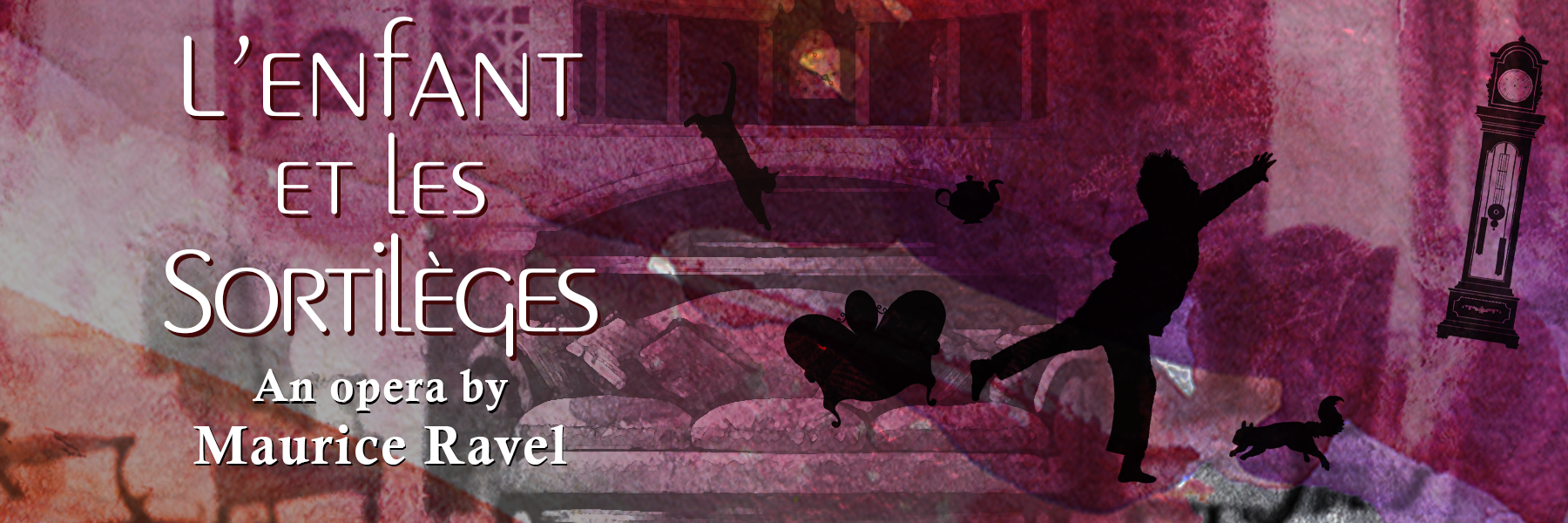
L'Enfant et les Sortilèges (The Child and the Magic Spells)
Music by Maurice Ravel
REDEMPTION FANTASTIQUE
Each evening will begin with a performance of Ravel’s iconic orchestral work, Boléro, followed by the opera, L’enfant et les sortilèges.
This one-act fantasy explores the enchantment and imagination of childhood when a young boy misbehaves, and all around him comes to life—assuming human qualities—to intervene.
Librettist and French icon Colette—actress, journalist, and one of the most influential and provocative writers of the twentieth century—wrote this piece in eight days as a “fantasy ballet.” When approached about making it a musical work, the only composer she was excited about was Ravel.
Once Ravel had the text, it would take him eight years to complete, following his two years at the front in WWI and the death of his beloved mother. It premiered in 1925. Colette’s wartime text met Ravel’s postwar music to create an imaginative work with a naughty child and magic at its heart.
Sensory warning: This production includes the use of theatrical fog/haze.
2025 Performances
Oct. 17, 18 Musical Arts Center 7:30 PM
Join us at 6:30 PM before each performance for the Opera Insights Lecture, located in the North Lobby of the Musical Arts Center.
Join Fawzi Haimor on Backstories as he dives into Ravel’s opera L’enfant et les sortilèges, exploring its story of compassion, inventive orchestration, dance, and international influences. Learn how the music brings characters to life and why this whimsical, modern work continues to captivate audiences.
Synopsis and Notes
by Sophia Torres (M.A. Musicology Student)
Setting: A House in Normandy, France Time: Early 1900s
Introduction The opera opens on an unnamed young boy bemoaning the many tasks and chores he has been assigned, and instead of completing his work, he fantasizes about all the naughty actions he would rather be committing, just to make his mother sorry. When his mother discovers his negligence, she punishes him by sending him to bed with only tea and dry toast for supper. The child flies into a tantrum, and in his gleeful destruction, he pokes the helpless squirrel’s paw, sweeps the teapot and teakettle onto the floor and shatters them, jostles the fire and sends up clouds of smoke, rips the wallpaper to shreds with the poker, rips away the balance from within the grandfather clock, and even tears the pages out of the fairy-tale book he used to love. He delights in his insolence, singing “I am free, free, wicked and free!”
Within the House He now moves to the armchair to rest after his flurry of wicked activities, but the armchair inexplicably breaks apart and hurriedly shuffles away from him. Confused, the boy looks on as the armchair begins to speak and greets a neighboring bergère. They begin to sing a stilted minuet (“Votre serviteur humble, Bergère”), lamenting the child’s poor treatment of his comfortable furniture. The boy barely has a moment to take in this magical turn of events before the grandfather clock springs to life as well, crying “Ding, ding, ding, ding . . . !,” lamenting that he cannot stop his chiming now that the child has broken his balance. One by one, all the mistreated objects in the house come to life, continuing with the teapot (“How’s Your Mug?”) and teacup (“Keng-ça fuo, mah-jong”) that rise, broken, from the floor. Then the fire leaps with vengeance from the fireplace (“Arrière! Je réchauffé les bons”), the shepherds and the shepherdess from the wallpaper lament their separation (“Adieu, pastourelles”), and the princess from the boy’s favorite storybook appears to him. By now, the child is completely distraught and overwhelmed, but at the sight of his beloved princess, his fear seems to vanish. He thinks, perhaps, that she will be the one to save him from his torment. Alas, he is mistaken. The princess sings (“Oui, c’est Elle”) to the boy and gently explains that, since he has ripped the pages from the book that she inhabits, he has put her to sleep forever. She asks, “Tell me, can you forever ignore my sad fate, the fate of your first and best beloved?” The child is heartbroken and desperately pleads with the princess to stay, but despite his best attempts to convince her that he can be her knight, she disappears. Once the princess vanishes, a little old man, accompanied by a chorus (“Deux robinets coulent dans un réservoir!”) appears and bombards the child with arithmetic. Once again, the child is overcome by their raucous singing, and even when he tries to answer, he is helpless to stop the mathematical onslaught. When his black cat then tries to approach and play with the boy, he rejects the offer, and the black cat hisses in reproach. Just then, the black cat spots the white cat outside in the garden and meanders outdoors. The boy is soon transfixed by their meowed duet (“Duo miaulé”) and joins them, transported into his familiar garden.
The Garden The quiet hum of the outdoors soothes the boy for a moment, but alas, his perils are not yet finished. He gladly leans against a tree he recognizes, singing “Ah! What a joy it is to find you again, my Garden!” (“Ah! Quelle joi de te retrouver, Jardin!”), but the tree utters a pained groan in response. Startled, the boy must now listen as a tree from which he peeled the bark sings a mournful tune, lamenting the wound the child inflicted upon him. Other trees soon join the song, “Our wounds . . . our wounds . . . They are still fresh and continue to bleed with sap . . . Wicked Child!” The child is overtaken by guilt, but now, other creatures buzz about him to remind him of the crimes he has committed against the dragonflies, the moths, and the bats. The dragonfly questions what has happened to their mate that the child captured (“Où es-tu, je te cherche . . .”), and he admits that he cannot make right what he has wronged: he has killed their mate and pinned the lost dragonfly to the wall. They remind him of how he pursued the bat with a stick and the cage in which he imprisoned the squirrel, who warns the frog that the same fate will befall him if he trusts the child. Amidst the squirrel’s warning, the garden comes alive with all manner of creatures dancing in joy while the child watches on, saying “They love . . . they forget me . . . I’m alone . . . ,” In a moment of desperation, he cries out, “Mother!”
The Finale Upon hearing the child’s call, the animals and trees become angry and begin to chant together as one, “The Child who loves not a soul and whom nobody loves. Shall he escape? No! He must suffer.” They enclose around him threateningly and move to hurt him, but instead, it is the squirrel that becomes injured in the chaos. The child, finally having a chance to help one of his victims, takes a ribbon and bandages the squirrel’s paw. The creatures are left shocked by his display of empathy and chatter amongst themselves, “See, he has dressed the wound . . . See, he has bound the paw and stopped the blood.” Amazed, they begin to aid the child in his cry, calling out “Mother!” one after another. They lift him to his feet and support him as they help move him from the garden back to the house safely. When they arrive, the boy calls out once more, and with their help, he is redeemed. He has set right what he has wronged, and he is finally allowed peace from his magical evening.
by Sophia Torres
Maurice Ravel’s beloved children’s opera, L’Enfant et les sortilèges, is a tale of an unnamed young boy who, when confronted with the magical consequences of his cruelty to the creatures and things around him, learns the error of his ways and chooses to show compassion to those he has abused. L’Enfant is a fantasy twist on a morality tale, and its premise—the animate and inanimate victims of a boy’s mischief come to life—naturally invites endless opportunity for imaginative staging and otherworldly costuming. However, the opera is much more than a story of childish callousness. L’Enfant underscores a truth that endures a century after its premiere and indeed throughout all time: the actions of kindness or cruelty we express towards one another ripple with unseen effects that stretch farther than we may ever imagine. If we get the chance to set right what we have wronged, what choice will we make?
When Ravel was first approached by the director of the Paris opera, he was asked to collaborate with the author Colette to produce a “fantastical ballet.” However, after discussing what the best medium for such a story might be, the pair settled instead on a one-act opera with ballet sequences choreographed by George Balanchine. Colette completed and submitted the libretto to Ravel in 1918, but it took the composer five years to complete the 60-minute opera. In 1925, L’Enfant et les sortilèges premiered in Monte Carlo to glowing critical acclaim, with one opening-night reviewer writing, “So successful and so delightful was the work that it will undoubtedly find its way to Paris next season, and then across to America in a short time.”
L’Enfant et les sortilèges is a children’s opera, but not a childish one. The story appeals to child audiences with its young protagonist and fantasy setting, and at the same time develops themes that compel listeners of any age: the mysterious life in everyday objects, childhood at the threshold of adult life, and the dawning of moral awareness. To call L’Enfant a “children’s opera” is not to diminish the weight of these themes, but simply to say that it is an opera told from the perspective of a child. Through the eyes of our protagonist, the fantastical is suddenly permissible, and impossibility itself becomes imaginary.
Ravel paints with bold colors in L’Enfant et les sortilèges, but it is in his subtler shading that he finds poignancy, darkness, and humor. The opera opens with a naughty child bored with his lessons and musing on what horrid things he would like to do instead of finishing his homework. When his mother punishes him for his laziness, he flies into a destructive tantrum. He gleefully tears through his possessions, ripping the wallpaper, breaking his prized teacup, and tearing up his favorite storybook. Now the fairy tale truly begins. The opera explodes into a vaudevillian variety show, with a cast of creatures appearing to the child in a brilliant succession of numbers. Each of these striking vignettes recounts the ordeal an object or animal has endured at the child’s hands, and each allows a brief glimpse into the branching consequence of the boy’s cruelty. As quickly as a creature appears, it retreats behind the curtain to make room for the next act. These arias, duets, and chorus numbers are jewels in the glittering crown of L’Enfant. One follows another in a brilliant succession of musical genres and styles, each infusing a new flavor into the music.
L’Enfant et les sortilèges pivots starkly between the heartfelt and the absurd, for example in the juxtaposition of the child’s despairing, regretful song, “Oh! Ma tête!” (Oh! My head!), with the bizarre yet undeniably romantic (even Tristanesque) cat duet, “Duo miaulé” (Meowed Duet). The opera’s soundscape is simultaneously charming and eerie, and Ravel wields it as a narrative tool, with the orchestra swelling and retracting with a swiftness that reflects the urgency of a child’s mind. Yet Ravel’s mercurial shifts in theme and tone are not hasty or slapdash. Through the medium of this fantasy, he captures one of the richest premises a storyteller could imagine: the crystallization of a child’s morality in real time.
Each creature enjoys only a short interval of time within the narrative of L’enfant, but the accumulation of their stories conveys just how many victims the child has tormented. The brevity of these moments enhances the moral underpinnings of the story, and the boy’s increasingly remorseful reaction to each character’s appearance indicates his burgeoning moral awareness. He has no time to apologize for the damage he has caused, for just as one creature proclaims its anguish, another appears to continue the lament. The pivotal moment of the boy’s journey is Princess’s aria, “Ah! C’est elle! C’est elle!” The Princess is a character from his most treasured storybook and seems to represent an ideal for the adult life he is only just beginning to glimpse. When we see how much he adores the Princess, we are finally able to empathize with him. The aria gives us an insight into the kind of man this boy longs to be: brave, strong, and above all, honorable. However, his actions have fallen far short of his aspirations, and now he feels the consequence of how thoughtlessly he has treated his book. There is a notable gravity to the Princess’s departure that signals the boy’s parting from his childhood ignorance. He now realizes that this consequence is permanent, and for the first time, he feels remorse for his actions. Thus, when the child later encounters the mate of a dragonfly he has killed and hears its heart-wrenching lament, “Où es tu? Je te cherche . . .” (“Where are you? I’m looking for you . . .”), he has no choice but to bear the weight of his prior acts.
In the finale, L’enfant et les sortilèges returns to one of the first animals the boy mentions: the squirrel, who only an hour before was the object of the boy’s giddy fantasies of torture. The child’s victims press in threateningly around him, but in the ensuing scuffle, it is the squirrel that becomes injured. In this moment, the boy finds the wisdom to choose a new path—mercy over cruelty. Instead of preying on vulnerability, he tenderly wraps the wound with a ribbon, and the creatures look on in awe. When given his chance, he makes a choice to do good, even though he is afraid. In this moment, he shows that he has truly changed, and the orchestra supports his newfound kindness with a return of the opening theme, now softened by soaring, glorious strings. As the creatures realize the change within the boy, they immediately cease their songs of vengeance and help the child call to his mother. The boy has changed for the better. No longer is he a mean, thoughtless child who rips the pages from his storybook; he can now write his own story and care for those he meets in it.
by Omer Ben Seadia
Maurice Ravel’s L’Enfant et les Sortilèges is often described as a “fairy-tale opera,” but at its heart it is a profound meditation on our relationship with the natural world.
In this production, we approach the piece through the lens of recycling and sustainability. The enchanted objects and animals that rise up against the Child are not simply magical inventions but the very things we discard, neglect, or misuse. Torn paper, broken furniture, empty bottles, and scraps of fabric come to life, reclaiming their dignity and reminding us that even the most ordinary or overlooked objects continue to carry meaning long after we believe we are done with them.
The opera’s fantasy world becomes a mirror of our own, where what is cast aside still speaks back to us. As the story unfolds, the stage is filled with reclaimed and repurposed materials, transforming what might otherwise be waste into a world of wonder. In this way, the opera itself becomes an act of renewal—an imaginative recycling where refuse is given revelation, and the discarded reveals its hidden magic.
The Child’s journey—from selfishness and destruction toward empathy and responsibility—also speaks to our age of overconsumption and our growing addiction to technology, which can so easily pull us away from the rhythms of the natural world. To listen, to care, and to reconnect becomes the true act of magic. In presenting L’Enfant et les Sortilèges through this ecological lens, I hope we are reminded that sustainability is not only a practical necessity but also a moral and imaginative act.
Artistic Staff
Ushering in a new era of artistic leadership, Fawzi Haimor is the newly appointed music director of the Marin Symphony, a role he assumed in July 2025. He becomes only the fourth music director in the orchestra’s distinguished 73-year history. In his inaugural season, he leads nine programs that reflect his hallmark balance of tradition and innovation, from symphonic masterworks to music by living and historically underrecognized composers. Praised for his “inspiring conducting,” “sensitivity and ability to create a defined, transparent sound,” and his “sense of drama and particular gift for strong, emphatic finishes,” Haimor has led major orchestras across the United States and internationally, including the National Symphony Orchestra, Indianapolis Symphony, BBC Symphony Orchestra, BBC Philharmonic, Edmonton Symphony, and Pittsburgh Symphony. In the 2025–26 season, he makes his debut with the Calgary Philharmonic and returns to the Jacobs School of Music for this production. Haimor served as music director of Germany’s Württembergische Philharmonie Reutlingen (WPR) from 2017 to 2020, leading the orchestra at its home venue, Stadthalle Reutlingen, and on tour throughout Germany and Europe. Together, they recorded three albums for CPO Records. Haimor’s extensive international engagements include performances with the Orchestre Philharmonique du Luxembourg, Orchestre de Chambre de Paris, NDR Radiophilharmonie Hannover, Deutsche Radiophilharmonie Saarbrücken Kaiserslautern, Orquestra Sinfónica do Porto Casa da Música, New Zealand Symphony, Orchestra Sinfonica di Milano Giuseppe Verdi, Odense Symphony, Kyoto Symphony, and Qatar Philharmonic, among others.
Israeli director Omer Ben Seadia is known for her inventive, thoughtful, and socially conscious productions. While garnering a name for herself in the classic repertoire, she also won praise for developing and promoting new opera worldwide; her contemporary classical world premieres include The Snowy Day (Thompson, Davis Pinkney) at Houston Grand Opera, which she revived at Portland Opera, and Thumbprint (Sankaram, Yankowitz) at Chautauqua Opera and at Portland Opera. She is deeply committed to the development and training of young artists and taught at Houston Grand Opera Studio and Young Artist Vocal Academy, Ryan Opera Center, Santa Fe Opera, Merola Opera Program, Rice University, International Vocal Arts Institute, Canadian Vocal Academy Institute, Aspen Music Festival, and Dandelion Opera Institute. Ben Seadia is a graduate of Seminar Ha’kibutzim, School of Performing Arts, with a degree in theater directing and a teaching degree in theater education. She completed the prestigious opera directing program at the Cincinnati College-Conservatory of Music, was an apprentice stage director at the Merola Opera Program, and began working extensively in the United States in 2012 after more than a decade with the Israeli Opera. She regularly leads and directs scene programs for major companies like The Opera Centre (San Francisco Opera), Lindemann Program (Metropolitan Opera of New York) and Domingo-Colburn-Stein Young Artist Program at Los Angeles Opera. Her recent productions include Rigoletto at Florentine Opera, Lucia de Lammermoor at Israeli Opera, Don Giovanni at Sacramento Philharmonic and Opera, Agrippina at Shepherd School of Music at Rice University, Ariodante at the Curtis Institute of Music, Die Zauberflöte at Opera Theatre of St. Louis, The Merry Widow at Calgary Opera, Atalanta at The Juilliard School, Rodelinda at Aspen Music Festival, Carmen and Ariadne auf Naxos at Cincinnati Opera, and The Rake’s Progress at Lakes Area Music Festival, among other titles. Future engagements include Rigoletto at Palm Beach Opera and Ariadne auf Naxos for Merola at San Francisco Opera.
Russell Long is the lighting specialist for the Musical Arts Center, where he has designed lights for Carmen, Suor Angelica, Trouble in Tahiti, Silence, Die Fledermaus, Eugene Onegin, An American Dream, Autumnsong, Roméo et Juliette, La Finta Giardiniera, and The Merry Widow. Long’s most recent regional design credits include Jersey Boys (QCT), High School Musical Jr. (SYP) Dial M for Murder, Forever Plaid (IUST), Newsies (QCT), The Music Man (QCT), Lunch Bunch (Clubbed Thumb), 45 Seconds from Broadway (Hudson Guild), and Aladdin Jr. (SYP). He has also worked as the lighting supervisor/resident lighting designer for the Aspen Music Festival and School, where he designed lights for Uncommon Ritual (Béla Fleck, Edgar Meyer, and Mike Marshall), ¡De Colores!, and Mathew Whitaker. Originally from Southern Arizona, Long studied at Pima Community College and Northern Arizona University and has worked with Arizona Theatre Company, Peaks Productions, University of Arizona Opera, Aspen Opera, and Vail Ballet Festival. He has also toured nationally as a lighting director, lighting designer, and production manager. He earned an M.F.A in Lighting Design from the IU Department of Theatre, Drama, and Contemporary Dance.
Walter Huff is professor of choral conducting and faculty director of opera choruses at the Jacobs School of Music. He served as chorus master for Atlanta Opera for more than two decades, leading the renowned ensemble in more than 125 productions, with critical acclaim in the United States and abroad. He earned a Bachelor of Music degree from the Oberlin Conservatory and a Master of Music degree from Peabody Conservatory. He studied piano with Sarah Martin, Peter Takács, and Lillian Freundlich, and voice with Flore Wend. After serving as a fellow at Tanglewood Music Center, he received Tanglewood’s C. D. Jackson Master Award for Excellence. Huff served as coach with the Peabody Opera Theatre, Washington Opera and has been musical director for The Atlanta Opera Studio, Georgia State University Opera. He also has worked as chorus master with San Diego Opera. He served on the faculty at Georgia State University for four years as assistant professor, guest lecturer, and conductor for the Georgia State University Choral Society. He has served as chorus master for many IU Jacobs School of Music Opera and Ballet Theater productions, including L’Étoile, Lucia di Lammermoor, West Side Story, The (R)evolution of Steve Jobs, Bernstein’s Mass, Parsifal, La Traviata, La Bohème, Die Zauberflöte, Falstaff, Highway 1, USA, La Rondine, H.M.S. Pinafore, Ainadamar, Anne Frank, Candide, The Merry Widow, Eugene Onegin, and Sweeney Todd. For five years, Huff served as choral instructor/conductor for the Jacobs School’s Sacred Music Intensive. He conducted the Jacobs Summer Music series presentations of Honegger’s King David, Paulus’s The Three Hermits, and The World of William Billings. This past summer, Huff returned for his seventh year as faculty coach at Ravinia Festival’s Steans Music Institute and in 2024, made his debut as guest chorus director with the Chicago Symphony Chorus in concert performances of Mozart’s Idomeneo with Chicago Symphony Orchestra (James Conlon, conductor). This season, Huff continues to serve as principal guest coach for the Atlanta Opera Studio Artists Program.
Born and raised in France, Elsa Quéron attended the Paris Conservatory for four years before moving to New York City in 2010 to pursue her studies at the Manhattan School of Music. Through vocal performance studies, she became increasingly interested in phonetics and diction and now specializes in French diction and repertoire coaching for opera singers. Quéron is the author of the translation and IPA libretti series French Operas by Elsa, which includes 22 operas and four aria anthologies, and has been used across the United States and the world in schools such as Indiana University, Arizona University, Manhattan School of Music, Mannes School of Music, and Melbourne Conservatory as well as companies such as the Glyndebourne Festival, Royal Danish Opera, and Lyric Opera of Chicago. Quéron was on faculty at the Manhattan School of Music in New York City from 2018 to 2024 and has taught artists at the Vincerò Academy, International Vocal Arts Institute, International Summer Opera Festival of Morelia, Minnesota Opera, and Mannes School of Music, to name a few.
Cori Ellison, a leading creative figure in the opera world, has served as staff dramaturg at Santa Fe Opera, the Glyndebourne Festival, and New York City Opera (NYCO). Active in developing contemporary opera, she is a founding faculty member and mentor at American Lyric Theater’s Composer Librettist Development Program and has developed new operatic works for companies including Glyndebourne, Icelandic Opera, Canadian Opera, Norwegian Opera, Opera Philadelphia, Chicago Opera Theater, Arizona Opera, Opera Birmingham, Pittsburgh Opera, Beth Morrison Projects, On-Site Opera, the Miller Theater, IU Jacobs Opera Theater, and Crane School of Music. She has served as production dramaturg for projects including Das Rheingold at Los Angeles Philharmonic; The Coronation of Poppea at Cincinnati Opera; Orphic Moments at the Salzburg Landestheater, National Sawdust, and Master Voices; Aci, Galatea, e Polifemo at National Sawdust and Philharmonia Baroque; Washington National Opera’s Ring cycle, Opera Boston’s The Nose, Offenbach!!! at Bard Summerscape, and La Finta Giardiniera at Indiana University. At The Juilliard School, she serves on the vocal arts faculty and is also a faculty member at the Ravinia Steans Music Institute Program for Singers. She has coached and taught master classes for singers at schools including the Indiana University Jacobs School of Music, Cincinnati College–Conservatory, University of Toronto, University of Michigan, Michigan State University, University of Texas at Austin, Boston University, Boston Conservatory, Mannes College, DePaul University, University of Illinois, Loyola University, Montclair State University, University of Utah, University of Nebraska at Lincoln, Florida International University, and Oklahoma State University, as well as the Crested Butte Opera Studio and Martina Arroyo’s Prelude to Performance program. Ellison regularly serves as a judge for the Metropolitan Opera Laffont Competition, Concurso San Miguel in Mexico, and many other vocal competitions. She creates supertitles for opera companies worldwide and helped launch Met Titles, the Met’s simultaneous translation system. Her English singing translations include Hansel and Gretel (NYCO), La vestale (English National Opera), and Shostakovich’s Cherry Tree Towers (Bard Summerscape). She has often written for The New York Times and has contributed to books including The New Grove Dictionary of Opera and The Compleat Mozart.
Lydia Spellman is a costume designer for film, opera, dance, and theater. Her most recent costume design credits include Roméo et Juliette for the Jacobs School of Music, Madeleines with the Jewish Theater of Bloomington, and the world premiere of Decolonizing Your Mind with Walter Mercado by Jayne Deely. She also created scenic designs for the 2022 TEDx Indiana University Conference and serves as resident wardrobe supervisor for IU Jacobs School of Music Opera and Ballet Theater. Originally from Central Illinois, Spellman earned a B.A. in Theatre and Linguistics from IU and has worked for several other performing arts organizations throughout the Midwest.
Olivia Essebaggers is a sophomore studying finance and arts management at Indiana University. This is her first production with IU Jacobs Opera Theater. She’s designed hair and makeup for five years, including works such as Mamma Mia! and Footloose, for which she received Sutton Foster Awards for Best Hair and Makeup Design in Michigan.
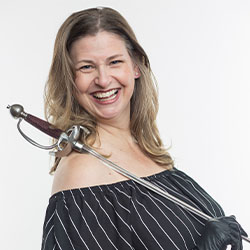
Gina Cerimele-Mechley is a nationally recognized movement/acting coach and Shakespearean teacher as well as one of the few female fight directors in the country with the Society of American Fight Directors. Her work as a performer, fight/intimacy director, and dance choreographer has been seen across the country at theaters such as the Tony Award-winning Denver Center Theatre Company, Alabama Shakespeare Festival, Sterling New York Renaissance Festival, Alaska Cabin Nite Dinner Theatre, Busch Gardens, Cincinnati Shakespeare Company, Cincinnati Ballet, Cincinnati Opera, Cincinnati Playhouse in the Park, Ensemble Theatre Cincinnati, and the Human Race Theatre in Dayton. Before deciding to have two children, she spent time in the stunt world as a motion capture artist for Nintendo. Cerimele-Mechley has taught in the theater departments of the Cincinnati College-Conservatory of Music, Xavier University, Northern Kentucky University, and Miami University, and at the Alabama Shakespeare Festival, where she also served as the resident dance choreographer. She prefers coaching students rather than being onstage herself, so she focuses much of her time on her nationally recognized educational theater company, Cincinnati Actor’s Studio & Academy, where students get the chance to work and perform next to professional artists on more mature material in preparation for college and beyond. Cerimele-Mechley was the first recipient of the Cincinnati Arts Association Arts Educator Award, awarded the U.S. Distinguished Teacher Award, nominated for the Excellence in Theatre Education Award from the Tony Awards, and knighted by the order of the Knights of Madoc, in honor of her “work in the art of stage combat and in recognition of her fine character and enduring good will.”
Cast
Sarai Burgos is a mezzo-soprano from Fairfax, Virginia, and a second-year master’s student in voice performance under the tutelage of Tichina Vaughn. In her first year, Burgos made her IU Jacobs Opera Theater debut as Prince Orlofsky in Die Fledermaus. This past spring, she portrayed Concepcion in Ravel’s L’heure Espagnole in the Opera Workshop of Carol Vaness and Zachary Coates. Burgos received a Bachelor of Music in Vocal Performance from Liberty University (LU) in Lynchburg, Virginia. With LU Opera Theater, she performed the roles of Cherubino (Le Nozze di Figaro) and Prince Orlofsky. She won the 2024 Concerto/Aria Competition and performed as a soloist with the LU Symphony Orchestra. She also spent three years as a young artist with Opera Roanoke, where she performed the role of Hansel (Hansel and Gretel) and Laetitia (The Old Maid and the Thief). In 2023, she portrayed Nerone in Chicago Summer Opera’s production of Agrippina. In 2022, Burgos was part of Opera Lucca and performed scenes from composers such as Mozart, Rossini, and Handel in the Tuscan countryside. She served as the alto soloist in Vivaldi’s Gloria with the University of Lynchburg Choral Union, in Bach’s Magnificat with the Jefferson Choral Society, and in excerpts from Handel’s Messiah with Opera Roanoke.
Mezzo-soprano Leah Nykaza, from Mahomet, Illinois, is a senior studying voice performance under the tutelage of Paulina Villarreal. This role is her IU Jacobs Opera Theater debut. At IU, she has also been a member of University Chorale, Pro Cantare, and the University Singers.
Chloe Hopson is a second-year mezzo-soprano from Indianapolis, Indiana, pursuing a Bachelor of Music in Voice Performance under the tutelage of Tichina Vaughn. She is a recent graduate of Perry Meridian High School, where she trained under her high school choir director Melissa Walsh and prior vocal instructor Rebecca Vernon. This year, Hopson was elected as the center president of Willkie Residence Hall and is also the appointed director of state relations for IU Student Government.
Mezzo-soprano Kathleen Simunek is a second-year master’s student at the Jacobs School of Music under the tutelage of Paulina Villarreal. A Midwest native raised in Fort Wayne, Indiana, Simunek graduated from Indiana University with a Bachelor of Science in Music (Voice) with an Outside Field in Political Science in 2024, studying with Timothy Noble. Last summer, she participated in the American Institute of Musical Studies (AIMS) Opera Studio in Graz, Austria, where she performed as a soloist in concert with the AIMS Festival Orchestra as well as in the Opera Scenes Concert. Last March, at The Studios of Key West, she performed the roles of Granny, Beata, and the Landlady in Martin Hennesy’s new work Swimming in the Dark. In 2024, Simunek was seen with IU Jacobs Opera Theater as Esther Klayman in the world premiere of The Amazing Adventures of Kavalier & Clay in collaboration with the Metropolitan Opera. With IU Jacobs Opera Theater, she has performed in the choruses of L’Étoile, Candide, The Merry Widow (Clo-Clo), Eugene Onegin, Sweeney Todd, Suor Angelica (Suor Dolcina), and Carmen. In 2023, she received the second-place award in the Oscar Hammerstein Solo Contest. During the summer of 2023, she studied in Vienna, Austria, through the Institute of European Studies as a performer and student manager. Simunek has also appeared in a variety of performance ensembles, including the IU Ballet Theater Nutcracker chorus, University Chorale, and Fort Wayne Children’s Choir.
Langelihle Mngxati has been praised for his “rich, fluid and fast-developing bass-baritone voice” by The San Diego Union Tribune. Recently, he has been featured as a bass soloist with the Eastern Illinois University Choir and Orchestra for its performance of Handel’s Messiah and as a soloist in Margaret Bond’s The Ballad of the Brown King in the Chimes of Christmas Concert with IU’s Singing Hoosiers. He recently collaborated and premiered songs by Pulitzer Prize-winning composer Anthony Davis. He enjoyed performances with the Kwa Zulu-Natal Philharmonic Orchestra while an undergraduate at the University of Kwa Zulu-Natal. Mngxati has performed roles with the Dallas Opera, Fort-Worth Opera, Opera NEO, Tri-Cities Opera, Paradox Opera, and Utah Music Festival Opera and Musical Theater. His awards include first place in the 7th Festival of Italian Opera Competition, Encouragement Award from the Metropolitan Opera National Council Auditions in the Houston District, Nathan Ward Memorial Award at Opera NEO’s Inaugural Voice Competition, and the Incentive Award in the Michael Ballam Voice Competition at Utah Festival Opera and Musical Theater. Mngxati is in his fourth year of the Doctor of Voice Performance program at Jacobs, studying with Peter Volpe. He holds a Performance Diploma and master’s degree from Southern Methodist University in Dallas, Texas, and earned a B.A. from the University of Kwa Zulu-Natal Howard College in Durban, South Africa. He is currently associate instructor for the IU African American Choral Ensemble.
Chinese Canadian mezzo-soprano Natalie Vong is a third-year D.M. in Voice Performance student under the tutelage of Brian Gill. Chosen as the 2025 recipient of the Wilfred C. Bain Scholarship and a 2024 recipient of the New Emerging Artist grant from the Canada Council for the Arts, Vong is an active performer and teacher of opera, classical singing, and music from all ages. Some of her past roles include Ruggiero (Alcina), La Badessa (Suor Angelica), Sesto (Giulio Cesare), Hansel (Hansel and Gretel), Third Lady (Die Zauberflöte), Praskowia (The Merry Widow), and Suor Mathilde (Dialogues of the Carmelites) as well as the opera choruses of Die Zauberflöte and Le Nozze di Figaro, across Canada, Italy, and the United States. Last summer, she portrayed Catherine in the world premiere of Canadian composer Colin Doroschuk’s Jéhanne with Opera Quest. She earned a Master of Music in Performance and Literature and a Bachelor of Music in Voice Performance at the University of Western Ontario, studying with Sophie Roland.
Baritone Evan Woods Gunter is a native of Birmingham, Alabama, pursuing a Doctor of Music in Voice Performance at the Jacobs School of Music, where he studies with Brian Horne. At Jacobs, he recently appeared as Moralès in Carmen. Additional operatic credits include Guglielmo in Così fan tutte and Moralès and El Dancaïro in Carmen at the University of Florida, Figaro in Le Nozze di Figaro, King Melchior in Amahl and the Night Visitors, the Pirate King in The Pirates of Penzance, and Gabey in On the Town at Samford University as well as Giuseppe Palmieri in The Gondoliers with the College Light Opera Company. In addition to his operatic work, Gunter has an extensive background in professional musical theater. A member of Actors’ Equity Association, he spent several years performing in New York City before beginning his graduate studies. Notable roles include the Beast in Beauty and the Beast (The Little Theatre on the Square), Robert in The Drowsy Chaperone (Maples Repertory Theatre), Rapunzel’s Prince in Into the Woods (Red Mountain Theatre Company), Marius in Les Misérables (Wallace Hall Fine Arts), and Quale in South Pacific (The REV). He holds a Bachelor of Music degree from Samford University and a Master of Music degree from the University of Florida.
Cody Horne is a baritone hailing from Louisville, Kentucky. He attended Belmont University to earn a bachelor’s degree, studying under the guidance of Mark Whatley. Now in the second year of a master’s degree, he is studying under the tutelage of Peter Volpe. Horne has performed the roles of Boaz in Ronald Beckett’s Ruth (Belmont University, 2022), Marco and Simone in productions of Gianni Schicchi (Marco, Canto Louisville, 2022 and Simone, Opera Lucca, 2023), Le Baron de Pictordu in Viardot’s Cendrillon (Belmont University, 2023), Baron Mirko Zeta in The Merry Widow (Belmont University, 2024), Le Dancaïre in Carmen (Indiana University, 2025), and, most recently, Belcore in Donizetti’s The Elixir of Love (La Musica Lirica, 2025).
Tenor Jeremiah Angel, from Evansville Indiana, is in the second year of a Master of Music in Voice Performance degree, studying with Kelly Markgraf. He has also studied with Timothy Noble and Gregory Rike. Angel holds dual bachelor’s degrees, in music education and music performance, from the University of Evansville Music Conservatory. There he appeared as Toby in The Medium and performed in notable concert performances of Vaughan Williams’ On Wenlock Edge and Britten’s Canticle II: Abraham and Isaac. Last spring, he made his Jacobs debut in the opera chorus of Carmen and is currently performing with NOTUS, IU’s contemporary vocal ensemble.
From Connecticut and Michigan, Katherine Alice Barbour is a graduate student at the Jacobs School of Music, studying with Deanne Meek and Bryan Hymel. She earned a B.A. in Music Performance from Denison University. Barbour has performed with various Young Artist Programs, including Opera Lucca, Lyric Opera Studio Weimar, and AIMS in Graz, where she has appeared in workshops, concerts, and opera productions. Additionally, she has portrayed Königin der Nacht and Papagena in Mozart’s Die Zauberflöte, and, at Jacobs, she has performed in opera workshops as Marie in Donizetti’s The Daughter of the Regiment, First Witch in Verdi’s Macbeth, and Pousette in Massenet’s Manon. This is her debut with IU Jacobs Opera Theater.
Originally from Seoul, South Korea, coloratura soprano Jisoo Choi is a second-year master’s student in voice performance under the guidance of Alice Hopper. During her undergraduate studies at Dankook University, Choi’s exceptional academic and musical achievements earned her a four-year full scholarship and graduation with highest academic honors and distinction. Having studied theater at Kaywon High School of Arts, she developed her stage presence and passion for storytelling through music. She has performed as Adele in Die Fledermaus, Despina in Così fan tutte, Romilda in Xerxes, and Paggio in Rigoletto with Seoul Metropolitan Opera at the 20th Daegu International Opera Festival. She was invited to perform at the 87th Chosun-ilbo Debut Concert, a prestigious stage honoring distinguished university graduates. Choi has also been active on the concert stage, appearing as the soprano soloist in Haydn’s Harmoniemesse, Schubert’s Mass No. 2, and Mozart’s Requiem. Most recently, she made her European debut as the Queen of the Night in Mozart’s Die Zauberflöte at the Croatian National Theatre, earning acclaim for her vocal agility and dramatic intensity. Her season continues in November with appearances as the soprano soloist in Bach’s Cantata and Mass with IU’s Historical Performance Institute and the Organ Department in addition to appearances in December as Sister Constance in Poulenc’s Dialogues of the Carmélites and the Dew Fairy in Humperdinck’s Hansel and Gretel.
Greek American soprano Pelagia Pamel is a second-year M.M. voice student on a performance fellowship studying with Heidi Grant Murphy at the Jacobs School of Music. In spring 2025, Pamel was the Governess in Britten’s The Turn of the Screw with IU Jacobs Opera Theater. She has sung roles in over a dozen opera productions at the young artist and professional levels with companies such as Detroit Opera and Czech National Opera. In 2023, she was hired by Detroit Opera for her first coproduction with the Metropolitan Opera, Ainadamar, performing as a singer and dancer in the production’s U.S. premiere. Last season, she debuted with IU Jacobs Opera Theater in the world premiere of The Amazing Adventures of Kavalier & Clay, her second coproduction with the Met. In addition to her work in the United States, Pamel has performed internationally in Vienna, Berlin, London, and Prague. Her most notable performance was singing Zerlina (Don Giovanni) at the historic Estates Theatre with the Prague Summer Nights Festival and Czech National Opera. Other highlights include her 2024 opera fellowship with the Manetti Shrem Opera Program at Festival Napa Valley, Diana (Orphée aux enfers), Soprano Soloist (Ein deutsches Requiem, Brahms), Beethoven’s Symphony No. 9 with the Detroit Symphony Orchestra, and numerous roles at the University of Michigan. Originally from Bloomfield Hills, Michigan, Pamel graduated with highest honors from the University of Michigan with a B.M. in Voice Performance and a B.A. in International Studies.
Soprano Maggie Stall, from Avon, Indiana, is working toward a Master of Music in Voice Performance degree from the Jacobs School, where she studies with Alice Hopper. Stall is also pursuing a Master of Arts in Speech Pathology degree and works in the Voice Physiology and Imaging Lab at Indiana University. She completed her undergraduate degrees in 2024 at Indiana University, where she earned a Bachelor of Music in Voice Performance as well as a Bachelor of Arts in Speech and Hearing Sciences. Past performances at IU include Fiordiligi/party guest in Die Fledermaus with an extended party scene (2024), opera chorus in Candide (Bernstein) in 2023 and the chorus in the summer 2023 performance of Dido and Aeneas (Purcell). Stall received an Honorable Mention at the Indianapolis Matinee Musicale undergraduate competition in 2024. She has also performed with the Hendricks Civic Theatre in the role of Mother Abbess in the summer 2024 production of The Sound of Music as well as in the summer 2025 production of The Secret Garden.
Nate Paul was born and raised in Strawberry Plains, Tennessee. His tenor voice has been described as “show-stopping and nothing less than thrilling” and as having “the presence of a stage-struck powerhouse” (Broadway World: Nashville). He is a three-time national Orpheus Voice Competition semifinalist, a Georgina Joshi Fellowship finalist, and a national semi-finalist in the NATS National Student Auditions. His recent performances include the North Dakota/Manitoba District of the Met Laffont Competition, Prologue/Peter Quint in The Turn of the Screw, Dr. Blind in Die Fledermaus, Njegus in The Merry Widow, and Beadle Bamford and Adolfo Pirelli in Sweeney Todd. He is a frequent concert soloist as well, having sung as the tenor soloist in Beethoven’s Mass in C Major, Telemann’s Die Donner-Ode, and Handel’s Messiah. Paul is also an award-winning music director and conductor, with some past works including La Cage aux Folles, Les Misérables, Seven Brides for Seven Brothers, The Wiz, Newsies, The Addams Family, Heathers, and The 25th Annual Putnam County Spelling Bee. A third-year doctoral student at IU studying with Brian Gill, Paul is an associate instructor teaching voice pedagogy and assisting in the Vocology Certificate program as well as serving on the voice faculty as an assistant professor of music at DePauw University.
Andreas C. Psillos is a baritone in his first year of the Master of Music program at the Jacobs School of Music, where he studies under Zachary Coates. He graduated from Rutgers University’s Mason Gross School of the Arts with a Bachelor in Voice Performance degree. In the fall of 2024, he made his Jacobs debut as Dr. Falke in Die Fledermaus then played Morales in last season’s production of Carmen. Other operatic roles include Maximilian (Candide) and Benoit (La Bohème) with Rutgers University Opera Theatre and Peter (Hansel and Gretel) at the Trentino Music Festival. Most recently, he performed Count Almaviva (Le Nozze di Figaro) with Opera Lucca in the summer of 2025. In concert, he has appeared as a soloist in Fauré’s Requiem and Benjamin Britten’s Rejoice in the Lamb with the Rutgers Kirkpatrick Choir. Other credits include Le Roi and Polonius (Hamlet), Lescaut and Le Comte des Grieux (Manon), and Bob (The Old Maid and the Thief) in the Graduate Opera Scenes Workshop.
Molly Singer is a senior studying voice performance under the tutelage of Michelle DeYoung at the Jacobs School of Music. She is also pursuing a minor in Jewish Studies. Hailing from West Hartford, Connecticut, this role is her IU Jacobs Opera Theater debut. Recent credits include performing as a soloist in an independent production of Jekyll and Hyde (directed by IU Theatre faculty professor Ainsley Valentine), scenes from Michael Shell’s Opera Workshop (Le Nozze di Figaro, The Old Maid and the Thief), and Suor Osmina in Suor Angelica as well as performing scenes (Le Nozze di Figaro, Orfeo ed Euridice) at Opera Lucca. Singer is also a clergy intern at Congregation Beth Shalom in Bloomington and director of Hooshir, IU’s premier Jewish a cappella group, and has led High Holy Day services at IU Hillel for the past three years.
Originally from Nashville, Tennessee, soprano Catherine Tamayo is a senior pursuing a Bachelor of Music in Voice Performance under the tutelage of Kimberly Gill. This is her debut role with IU Jacobs Opera Theater. She has been seen in the chorus of previo
Coloratura soprano Morgan Feeney-Davies, from San Diego, California, is pursuing a Bachelor of Music with a minor in Italian Language and Culture under the vocal direction of Alice Hopper. Some of her past roles include Königin der Nacht (Die Zauberflöte) with Berlin Opera Academy, Esther (Meet Me In St. Louis) with Viani Performing Arts Academy, Cosette (Les Misérables) with Steele Canyon Players, and Maria (The Sound of Music) with Steele Canyon Players. Feeney-Davies has also been featured on KUSI News for three separate events, including a featured solo of Beyoncé’s “Love On Top” and Ralph Blane’s “The Trolley Song” and was also featured as a School Girl Extra in the movie Miracle At Manchester (2022), a JCFilm by Jason Campbell and Eddie McClintock. When she is not onstage, she is happily assistant stage managing at the Musical Arts Center with operas including Carmen (2025), Kavalier and Clay (2024), Sweeney Todd (2024), Eugene Onegin (2024), and Roméo et Juliette (2023). This role is her IU Jacobs Opera Theater debut.
Brynn Jacobs is making her IU Jacobs Opera Theater debut in this production. Originally from Lancaster, Pennsylvania, and based in New York City, she is a second-year graduate student pursuing an M.M. in Voice Performance and a Certificate in Vocology under Brian Gill. She received a B.M. in Vocal Performance from NYU Steinhardt in the studio of Kathleen Adams. Previous roles and engagements include Despina in Così fan tutte at the Vienna Opera Academy, Soprano Chorister in the New York Philharmonic Chorus, and at NYU, Diana in Orpheus in the Underworld, Amore in Gluck’s Orfeo ed Euridice, Dater #38 in Zoom Speed Dating Tonight!, Opera Chorus and Assistant Stage Manager in Die Zauberflöte, and Susanna in Mozart Scenes & Prima la musica e poi le parole. IU credits include SNATS President (2025-26), IU Summer Chorus (2025), University Chorale (2024-25). She is also coproducer and principal vocalist for Inspiration!, a short film in New York.
Hailing from Sacramento, California, 19-year-old soprano Tiara Thankam Abraham is in her second year of doctoral studies in voice performance, studying with Michelle DeYoung. Praised for her bell-like clarity, agile coloratura, and expressive acting skills, Abraham has performed as a soloist globally, including at Carnegie Hall, the Vatican, and Musikverein in Austria as well as on national TV and NPR affiliate radio stations. She has performed as Zerlina in Don Giovanni with Greve Opera Academy and Belinda in Dido and Aeneas at the Chicago Summer Opera. She has also performed scenes as Susanna in Le Nozze di Figaro, Hero in Beatrice et Benedict with Opera Workshop at Jacobs, and in the opera chorus of IU Jacobs Opera Theater’s production of Eugene Onegin. Most recently, she performed as Miles in IU’s production of Britten’s The Turn of the Screw. As a concert soloist, she has performed with the Camellia Symphony Orchestra and UC Davis Symphony Orchestra, where she performed as the soprano soloist in Bach’s Magnificat. Abraham has also won numerous national and international competitions, including first prize in the 2025 George Shirley Vocal Competition. In Bloomington, she is a choral scholar at First Christian Church. She currently serves as social media manager for IU’s chapter of Student National Association of Teachers of Singing.
Originally from China, soprano Yixin Yang is a second-year master’s student under the guidance of Carol Vaness. She earned bachelor’s degree in voice and opera performance from the Central Conservatory of Music in Beijing. Her operatic roles include Norina in Don Pasquale, Zerlina in Don Giovanni, Giannetta in The Elixir of Love, and First Lady in Die Zauberflöte. She has also appeared in the choruses of Così fan tutte, La Bohème, and La Cenerentola and is a member of NOTUS. This production marks her debut with IU Jacobs Opera Theater.
Armenian Uzbek soprano Anna Seda Ambartsumian has versatile experience on stage and behind the scenes. Recent performance credits include La Suora Infermiera in Suor Angelica with IU Jacobs Opera Theater and scenes performances as Adriana in Adriana Lecouvreur. In 2023, Ambartsumian performed the Mozart Requiem with the Pittsburgh Symphony Orchestra and the Mendelssohn Choir of Pittsburgh, and she was the soprano soloist in Handel’s Messiah with the Columbus Philharmonic Orchestra. Previous IU Jacobs Opera Theater credits include the opera choruses of Carmen, The Amazing Adventures of Kavalier & Clay, the world premiere of Anne Frank by Shulamit Ran, Falstaff, and La Rondine. This past summer, Ambartsumian completed the Metropolitan Opera summer internship program in New York City, working in the Production and Season Planning department. She is a second-year M.M. student studying under the tutelage of Jane Dutton. She recently earned a B.M. in Voice Performance from Jacobs and is in her third year as the administrative production assistant with IU Jacobs Opera and Ballet Theater.
Soprano Ambriehl Ivy is a native of Brandon, Mississippi, completing a Performance Diploma in Voice at the Jacobs School of Music. She earned a Bachelor of Music in Vocal Performance from Mississippi College in 2024. Ambriehl made her collegiate lead debut as Laetitia in The Old Maid and the Thief (Menotti) in 2022, followed by her portrayal of Micaëla in Bizet’s Carmen (2023). That same summer, she joined Spotlight Opera as a young artist, performing La Sorella Infermiera in Suor Angelica, Nella in Gianni Schicchi, and Mama Bear in the children’s opera Goldie B. Locks and the Three Singing Bears. She was also named a young artist with Opera Mississippi for the 2023–24 season. In 2024, Ambriehl appeared as the soprano soloist in Damien Peter’s Cantata for a More Hopeful Tomorrow with the Mississippi College Singers. Most recently, she was selected to workshop the role of Tasha in In the Rush by Carlos Simon—a collaboration between the Jacobs School of Music and the Metropolitan Opera (January 2025).
Nina Royston, a Chicago native, is a second-year Master of Music student at the Jacobs School of Music, where she studies with Peter Volpe. She also earned her bachelor’s degree from the Jacobs School. Royston recently performed the roles of Adina and Giannetta in Donizetti’s The Elixir of Love with La Musica Lirica, and in 2023, she sang the role of Genovieffa in Puccini’s Suor Angelica with Opera Lucca. On the MAC stage, she has appeared in the opera choruses of Carmen, Eugene Onegin, and Roméo et Juliette as well as in The Amazing Adventures of Kavalier & Clay in collaboration with the Metropolitan Opera.
Soprano Kirsten Tierney is a senior pursuing a bachelor’s degree in voice performance with a minor in history under the tutelage of Jane Dutton. Hailing from Falls Church, Virginia, this is her debut role with IU Jacobs Opera Theater. Previously, she performed as Alice in Michael Shell’s Opera Workshop’s scenes of Falstaff. In 2024, she attended the Queens Summer Vocal Institute in Flushing, New York, where she performed as Mrs. Gobineau in The Medium.
Hailing from Moorestown, New Jersey, Julianna Banfe is a third-year undergraduate pursuing a Bachelor of Music in Voice Performance under the instruction of Paulina Villarreal. She recently made her operatic role debut as Celia in Silla with Chicago Summer Opera, where she studied with Hungarian mezzo-soprano Viktoria Vizin. At Jacobs, Banfe has performed with NOTUS, the Oratorio Chorus, and Conductors Chorus. She is also the cofounder and co-music director of The Bloomingtones, an all-treble a cappella group at IU. This production marks her debut with IU Jacobs Opera Theater.
Soprano Emma DiSanto, hailing from Indianapolis, Indiana, is a second-year graduate student at the Jacobs School of Music pursuing a Master of Music in Voice Performance under the tutelage of Heidi Grant-Murphy. She previously earned a Bachelor of Music in Voice Performance with a minor in Arts Administration at Jacobs. She has been featured in the choruses of The Merry Widow, Eugene Onegin, Die Fledermaus, L’Enfant et les Sortilèges, and Mason Bates’s The Amazing Adventures of Kavalier & Clay, a coproduction between IU Jacobs Opera Theater and the Metropolitan Opera. She was seen as Morgana in Handel’s Alcina with IU Jacobs Opera Theater in February 2025. Outside of IU, she premiered Mondo Novo as Philomela at the Vienna Summer Music Festival in Florida, then made her international debut in Vienna as Suor Genovieffa (Suor Angelica) and covered Queen of the Night (Die Zauberflöte). Other opera credits include Erste Dame (Die Zauberflöte) with the Berlin Opera Academy and, more recently, Gilda (Rigoletto) with the La Musica Lirica program in Novafeltria, Italy. She will compete in the district round of the Metropolitan Opera Laffont Competition this season.
101 North Eagleson Avenue Bloomington, IN 47405 Monday–Friday | 11:30 a.m.–5:30 p.m. Box office hours are subject to change during events and holidays.
Group Sales
Discounted rates are available for groups of 10 or more. Call us at 812-855-0021 for details.